
Why understanding the regional differences matters for integration, automation, and APIs
If you have ever searched online for “Sage 50 integration” or “Sage 50 API,” you may have noticed a great deal of conflicting or outright misleading information. That confusion is not accidental—it stems from a fundamental misunderstanding of what Sage 50 actually is.
Despite the shared branding, Sage 50 is not a single global accounting product. It is a brand name applied to several completely different accounting systems, each developed independently, for different markets, using different technologies, and governed by different tax and compliance rules.
This distinction is critical—especially if you are looking to integrate Sage 50 with other business systems such as e-commerce platforms, CRMs, WMS solutions, or bespoke operational software.
Sage 50 Is a Brand, Not a Single Product
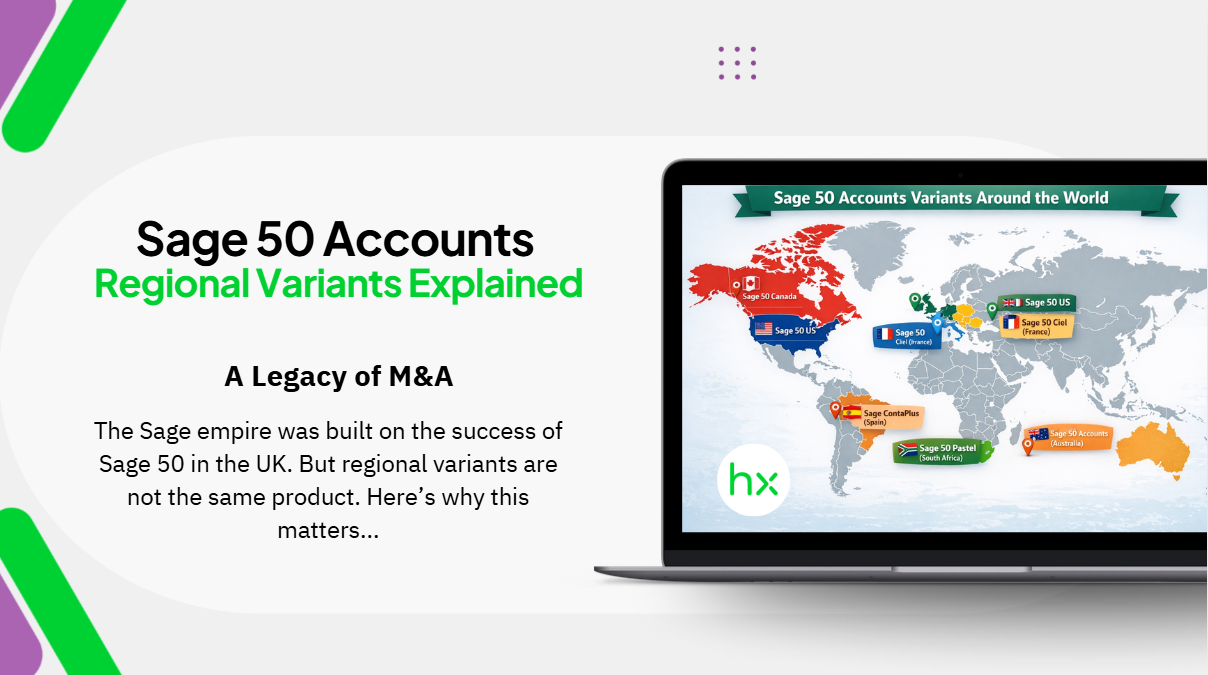
Sage’s growth strategy over several decades involved acquiring dominant regional accounting packages and later rebranding them under the Sage umbrella. As a result, “Sage 50” is a label applied to at least seven distinct accounting systems worldwide, not regional editions of the same software.
Each variant has its own:
-
Codebase and architecture
-
Data model
-
Integration capabilities
-
API availability (or lack thereof)
-
Compliance and localisation features
The Major Regional Variants of Sage 50
🇬🇧 UK & Ireland – Sage 50 Accounts
The UK & Ireland version of Sage 50 Accounts traces its lineage back to the original Sage Sterling product. It is a desktop-based accounting system, widely used across:
-
The United Kingdom
-
Ireland
-
Malta
-
Parts of Africa
-
Australia and New Zealand
This version is currently at version 33.0 and remains one of the most widely deployed SME accounting systems in the UK and Ireland. Crucially, it does not include a native real-time API.
🇺🇸 United States – Sage 50 US
The US product was originally Peachtree Accounting, rebranded as Sage 50 in 2013. Despite sharing the name, it is an entirely different system with its own:
-
Database structure
-
SDKs and integration approaches
-
Third-party ecosystem
Many online references to “Sage 50 APIs” actually relate only to this US product, which causes significant confusion for UK users.
🇨🇦 Canada – Sage 50 Canada
Formerly Simply Accounting (and earlier Bedford Accounting), this product is developed in British Columbia and includes features such as:
-
Native multi-currency support
-
Bilingual English/French interfaces
Again, it is technically unrelated to the UK product despite the shared branding.
🇫🇷 France – Sage 50 Ciel
Originally developed by Ciel, a French accounting software company acquired by Sage in 1992. This product is tailored specifically for French accounting and tax rules.
🇩🇪 Germany & 🇦🇹 Austria – Sage 50 GS-Office
Previously GS-Office, this solution was rebranded as Sage 50 in 2015 and is designed specifically for German-speaking markets.
🇪🇸 Spain – Sage ContaPlus
ContaPlus, acquired by Sage in 2003, has over a million users in Spain. It remains one of the most popular accounting platforms in that market and is entirely distinct from other Sage 50 variants.
🇿🇦 South Africa – Sage 50 Pastel
Formerly Pastel Accounting, this product dominates the South African SME market and operates independently from other Sage 50 systems.
Seven Products. One Name. Significant Confusion.
To summarise:
There are at least seven distinct accounting products worldwide that all share the Sage 50 name.
They are not interoperable, not architecturally similar, and not supported by the same APIs or integration tools.
This is why advice, documentation, or software claiming to support “Sage 50” often fails when applied to the UK & Ireland version.
Sage 50 Accounts UK: The Integration Reality
The UK & Ireland edition of Sage 50 Accounts:
-
Is a desktop application
-
Stores data locally or on a Windows server
-
Has no native real-time REST API
-
Was not designed for modern cloud-based integration
As a result, many businesses struggle when attempting to:
-
Automate data flows
-
Connect Sage 50 to Shopify, HubSpot, Pipedrive, or WMS platforms
-
Build bespoke operational systems around their finance data
The Only Real-Time API for Sage 50 Accounts UK & Ireland
This is precisely the gap that HyperAccounts REST API was built to solve.
HyperAccounts is:
-
The only true real-time REST API for Sage 50 Accounts UK & Ireland
-
Fully compatible with Sage 50 v33.0
-
Designed specifically for UK and Irish compliance requirements
-
Proven in production across thousands of live Sage companies
-
Capable of supporting high-volume, mission-critical integrations
Unlike file exports, scheduled imports, or fragile ODBC-based approaches, HyperAccounts delivers:
-
Real-time data synchronisation
-
Transactional integrity
-
Full control over Sage master data and financial documents
-
A modern REST interface suitable for cloud, SaaS, and bespoke systems
Why This Distinction Matters
If you are:
-
A UK or Irish business using Sage 50 Accounts
-
A software vendor building integrations
-
A digital agency delivering automation projects
-
An operations team trying to reduce manual data entry
Then it is essential to ensure that:
-
The solution explicitly supports Sage 50 Accounts UK & Ireland
-
It is compatible with your exact Sage version
-
It offers real-time integration, not batch or delayed synchronisation
Anything less introduces risk, technical debt, and operational fragility.
Final Thoughts
The Sage 50 brand masks a complex global landscape of unrelated accounting systems. Understanding which product you are actually using—and what integration options genuinely exist—is the first step toward building reliable, future-proof business systems.
For organisations running Sage 50 Accounts UK & Ireland, HyperAccounts REST API remains the only proven, real-time integration platform built specifically for this market.
If clarity, reliability, and real-time financial data matter to your business, the distinction is not academic—it is fundamental.